
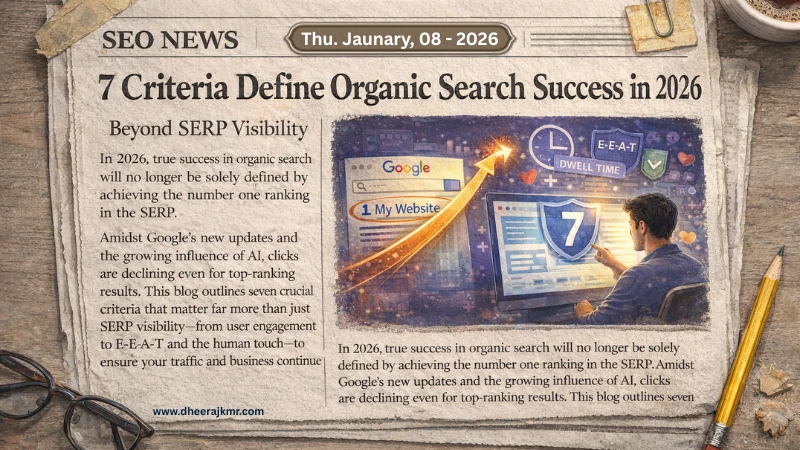
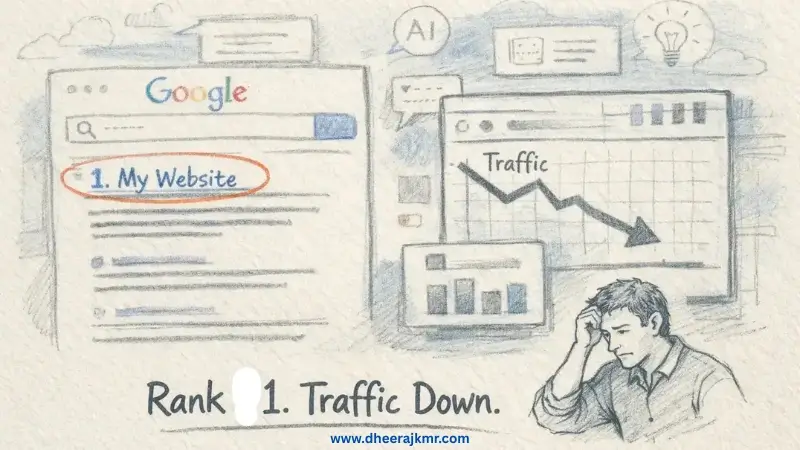
Imagine a world where your website ranks 1 for your “money keyword,” yet your traffic is dropping. This isn’t a dystopian nightmare; it is the reality of organic search success in 2026.
For over two decades, “SERP visibility“—fighting for that top blue link—was the holy grail of digital marketing. But the landscape has shifted tectonically. With the maturity of Google’s Search Generative Experience (SGE), the explosion of zero-click searches, and the rise of answer-based AI agents, the old playbook is obsolete. In 2026, visibility alone is vanity; value is sanity.
Why is traditional SEO failing? Because users no longer just “search”; they interact with intelligent layers that synthesize answers before they ever reach a website. If your strategy is still obsessed with 2023-era keyword rankings, you are optimizing for a ghost town.
To achieve true organic search success today, we must look beyond the rank. We must look at the ecosystem of trust, engagement, and entity authority.
In this comprehensive guide, we will dismantle the old metrics and build a new framework for the future. We will explore the 7 critical criteria that define organic search success in 2026—factors that algorithms now prize more than simple keyword placement. From the nuances of E-E-A-T to the technical demands of Core Web Vitals, this is your blueprint for survival and growth.
1. User Experience & Engagement Metrics: The New “Rank”
In 2026, Google’s algorithm has evolved from a referral engine to a satisfaction engine. The most critical shift for organic search success in 2026 is the realization that getting the click is easy; keeping the user is hard.
Why This Matters in 2026
Traditional ranking factors like backlink counts have been devalued in favor of behavioral signals. Google now heavily weighs “Interaction to Next Paint” (INP) and “Return to SERP” rates. If a user clicks your link but immediately bounces back to the search results (pogo-sticking), your “success” is an illusion. The algorithm interprets this as a failure to satisfy intent.
Key Trend: In 2026, User Experience (UX) is not just a design discipline; it is an SEO discipline.
How to Optimize for Engagement
You must optimize for the “Post-Click Experience.” This involves:
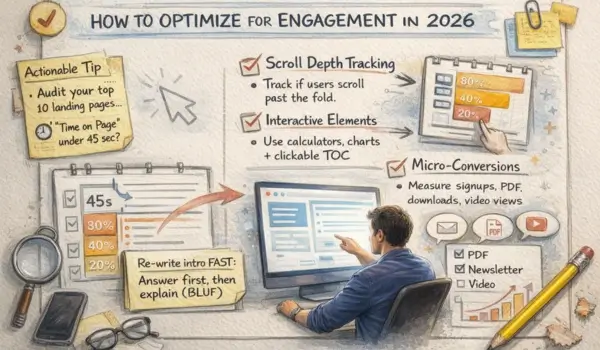
- Scroll Depth Tracking: Do users read past the fold? If 80% of your traffic leaves before reading 20% of the content, you are signaling low relevance.
- Interactive Elements: Static text is dead. Incorporate calculators, interactive charts, and clickable table of contents to arrest the user’s attention immediately.
- Micro-Conversions: Don’t just ask for a sale. Measure success by newsletter signups, PDF downloads, or video views. These “dwell time” boosters signal to Google that your page is a destination, not a pit stop.
Actionable Tip: Audit your top 10 landing pages. If the “Time on Page” is under 45 seconds, rewrite your intro. Hook the reader instantly with the “BLUF” method (Bottom Line Up Front)—give the answer first, then explain.
2. E-E-A-T and Author Authority: The Trust Currency
E-E-A-T (Experience, Expertise, Authoritativeness, and Trustworthiness) was a buzzword in 2023. In 2026, it is the filter that separates valid content from AI sludge.
The Rise of “Experience”
Google’s spam updates have become ruthless against generic content. The “E” for Experience is paramount. Algorithms can now detect whether content was written by someone who did the thing or someone who just read about it.
Why SERP Visibility Fails Without E-E-A-T
You might rank #1 for “best hiking boots,” but if your review lacks original photos, first-person anecdotes, and verified author credentials, your ranking will decay. AI Overviews prioritize citing sources that demonstrate verifiable expertise.
Strategies for Building Authority
- Robust Author Bios: “Written by Admin” is SEO suicide. Every post must be attributed to a real human with a linked LinkedIn profile and a dedicated author page showcasing their credentials.
- Digital Footprint: Your authors need to exist outside your blog. Are they quoted in other industry publications? Do they speak on podcasts? Google maps these “knowledge graph” connections.
- First-Hand Evidence: Stop using stock photos. Use original screenshots, photos of the product in your hand, or videos of you performing the service.
Hypothetical Scenario: Two sites write about “Fixing a leaky faucet.” Site A uses AI to generate generic steps. Site B features a video of a plumber (the author) actually holding the wrench, with a bio linking to their plumbing certification. In 2026, Site B wins organic search success, even if Site A has more backlinks.
3. Content Depth, Helpfulness & Originality: Beyond AI Wrappers
The internet of 2026 is flooded with “gray goo”—content generated by AI models looping on themselves. To achieve Google ranking factors 2026 success, you must produce what AI cannot: Insight.
The “Information Gain” Score
Patents suggest Google now uses an “Information Gain” score. If your article repeats the same points as the top 10 results, it has a score of zero. You must add something new—a new data point, a contrarian opinion, or a unique case study.
Defining “Helpfulness”
Helpful content in 2026 isn’t just accurate; it’s actionable.
- Don’t tell me what a marketing plan is.
- Give me a downloadable template and a 5-minute video walkthrough of how to fill it out.
Strategies for Originality
- Conduct Original Research: Survey your email list and publish the data. “State of the Industry 2026” reports attract massive backlinks because they are primary sources.
- Opinionated Content: AI is neutral. Humans have opinions. Take a stand on industry trends. “Why X Strategy is Dead” works because it invites debate.
- The “Human” Angle: Weave personal stories into technical content. “How I failed at X and what I learned” is more valuable than “10 Tips for X.”
![Image Suggestion: organic-search-success-content-depth.jpg – Alt Text: Comparison of generic AI content versus high-depth original human content for organic search success in 2026]
4. Technical Performance & Core Web Vitals: The Infrastructure of Speed
While content is king, infrastructure is the castle. You cannot have organic search success if the drawbridge is stuck.
Core Web Vitals as a Baseline
In 2026, passing Core Web Vitals (CWV) is not an advantage; it is the bare minimum entry ticket. Google has tightened the thresholds for LCP (Largest Contentful Paint) and CLS (Cumulative Layout Shift)
The New Technical Frontier: “Crawl Budget for AI”
It’s not just Googlebot crawling you anymore; it’s LLM bots (like ChatGPT-User, Google-Extended).
- Render Efficiency: Heavy JavaScript frameworks that require massive processing power to render are being deprioritized. Server-Side Rendering (SSR) or Static Site Generation (SSG) is crucial.
- Structured Data (Schema) 2.0: This is the most underrated factor of 2026. You must use nested, complex schema markup. Don’t just mark up an “Article.” Mark up the “Author,” who is a “Person,” who works for an “Organization,” that sells a “Product.” Connect the dots for the bot.
Action Item: Use the speakable schema and FAQPage schema aggressively. These are the languages of Voice Search and AI Chatbots.
5. Semantic Search & Entity Optimization: Speaking the Algorithm’s Language
Keywords are strings of characters. Entities are concepts. Organic search success in 2026 relies on Entity SEO.
Moving Beyond Keywords
Google’s Knowledge Graph understands that “Apple” is an entity that can be a fruit or a tech giant, depending on the context. Your content must clearly define which entities it relates to.
Topic Clusters and Semantic Connectivity
Instead of writing 50 isolated blog posts, build a “Knowledge Hub.”
- Pillar Page: The broad topic (e.g., “Digital Marketing”).
- Cluster Content: Specific sub-topics (e.g., “SEO,” “PPC,” “Email Marketing“) that link back to the pillar.
This structure tells Google you are an authority on the entire entity of Digital Marketing, not just a lucky ranker for one keyword.
How to Optimize for Entities
- Natural Language Processing (NLP): Use tools like SurferSEO or Clearscope to identify the “salient terms” and related entities your competitors are missing.
- Disambiguation: Be explicit. “We are discussing Python the programming language, not the snake.”
- Internal Linking: Use descriptive anchor text that reinforces the relationship between pages.
“In the era of semantic search, context is the new keyword density.”
6. Multi-Channel Integration & Omnipresence: Search is everywhere
Beyond Google
Organic search success in 2026 means visibility on all search engines, not just Google.
- YouTube SEO: Video snippets dominate Google SERPs. If you don’t have a video strategy, you are invisible in 25% of queries.
- Social Search: Optimize your social profiles with keywords. People search Instagram for “wedding photographers,” not just hashtags.
- Podcast SEO: Audio is indexed. Google transcribes podcasts. If you are a guest on a high-authority podcast, that is a massive entity signal.
The “Brand as a Platform” Approach
You want users to search for your brand name + topic (e.g., “HubSpot marketing tips”). This “Navigational Intent” is the strongest signal of authority. You achieve this by being omnipresent—appearing in their inbox, their social feed, and their search results simultaneously.
![Image Suggestion: multichannel-seo-strategy-2026.jpg – Alt Text: Diagram showing multi-channel integration for organic search success in 2026 beyond SERP visibility]
7. AI-Resistant Content & Human Touch: The Premium Differentiator
Finally, the most philosophical yet practical criterion. As AI content becomes free and infinite, human content becomes premium and scarce.
The “Turing Test” for Content
Can a reader tell a human wrote this? If not, you are a commodity. SEO success 2026 belongs to those who inject personality, empathy, and vulnerability.
Strategies to “De-Robot” Your Content
- Use “I”, “We”, and “You”: Direct address builds connection.
- Storytelling: Open with a narrative. “I remember when I first tried to optimize a site in 2015…” AI doesn’t have memories.
- Curated Expertise: Instead of listing 10 tools, explain why you chose them and which one you actually use.
- Community Integration: Embed user comments or forum discussions into your articles. It shows a living, breathing community exists around your content.
Future Projection: We may soon see a “Verified Human” tag in SERPs, similar to Twitter’s blue check. Prepare for this by building a brand that screams humanity.
Wrapping Up:
The era of tricking the algorithm is over. Organic search success in 2026 is not about finding a loophole in Google’s code; it is about aligning your entire digital existence with the goal of being the best answer.
To thrive beyond simple SERP visibility, you must:
- Prioritize Engagement over empty clicks.
- Prove your E-E-A-T with verifiable authors.
- Provide Information Gain, not just recaps.
- Ensure Technical Excellence for both humans and bots.
- Speak in Entities, not just keywords.
- Be Omnipresent across video and social.
- Infuse every word with the Human Touch.
The websites that will dominate in 2026 are not just SEO projects; they are brands. They are authorities. They are destinations.
Are you ready to stop chasing algorithms and start building authority?
FAQ:
Q1: What is organic search success in 2026 defined by?
Organic search success in 2026 is defined by high-quality user engagement, brand authority (E-E-A-T), and visibility across multiple platforms (omnipresence), rather than just the ranking position of a single keyword.
Q2: Why is SERP visibility no longer enough for SEO?
With the rise of Zero-Click searches and AI Overviews, users often get their answers without clicking a link. Therefore, visibility doesn’t guarantee traffic. You need to optimize for brand recognition and being the “cited source” in AI answers.
Q3: How important is E-E-A-T for SEO in 2026?
It is critical. Google’s algorithms now aggressively filter out content that lacks clear expertise and authoritativeness. Verified author bios and first-hand experience are essential ranking factors.
Q4: What are the key Google ranking factors in 2026?
Key factors include User Experience signals (like interaction rates), Content Depth (Information Gain), Entity Authority, Core Web Vitals, and Mobile-First indexing.
Q5: How does AI affect organic traffic growth in 2026?
AI may reduce top-of-funnel informational traffic due to direct answers in SERPs. However, it increases the value of high-intent traffic. Success comes from targeting complex queries that AI cannot easily summarize.
Q6: What is “Information Gain” in SEO?
Information Gain is a measure of how much new information your content provides compared to other search results. Google rewards content that adds original data or unique perspectives rather than rehashing existing articles.
Q7: How do I optimize for Entity SEO?
Focus on topics, not just keywords. Use structured data (schema markup) to define people, places, and concepts. creating comprehensive “pillar pages” that cover a topic in-depth helps Google understand your authority on an entity.
Q8: Will keywords still matter in 2026?
Yes, but as part of a semantic context. Exact-match keyword stuffing is dead. You need to use natural language that covers the intent and related concepts (entities) surrounding the keyword.